|
|
Building Control.
LABC has a web site here and this page lists 10 good reasons for building control.
But it is one of those services government allowed to privatise.
Some say, the privateers cherry pick the best jobs leaving local authorities those jobs that are hard to fulfill for the fee.
That results in the privateers being able to offer better money and poaching many inspectors from local authorities.
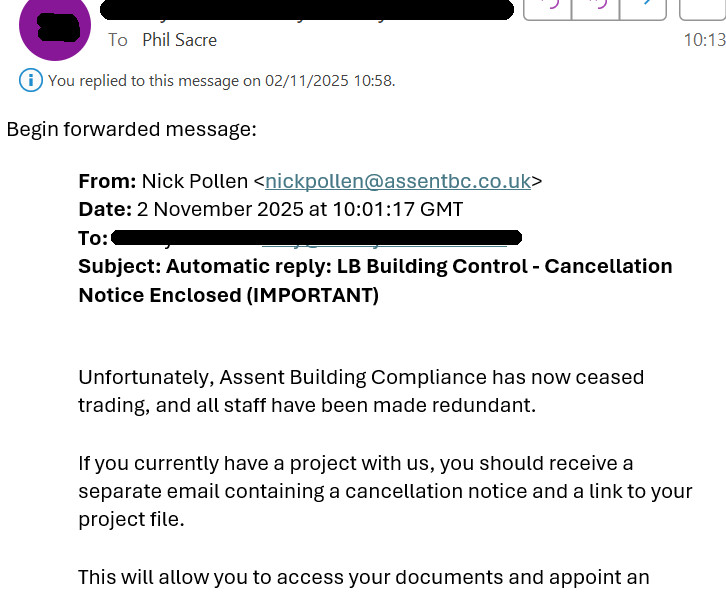
But, despite this relatively easy money, the Assent group managed to go into liquidation November 2025.
In my experience, the privateers often bundle up building control and structural warranty insurance into one package. They wear two hats. Building better and wriggling out of a future insurance claim.
I find that the privateers rarely come to site, but worse: they show no flexibility to recognise that a situation on site can be built better than the architect envisaged on the drawing board months earlier.
When I have tried to use my initiative, for instance at the bottom of the dig for an underpin if I find the soil is quite different to what was expected, and I try to do a better job, if I call in the inspector to see it his response is to write a report that I am not building to the drawing - which might have become impossible given what we found.
The report means if the client claims on his structural warranty, he will be turned down because of the discrepancy.
But you cannot stop having excavated an underpin for 2 months while the architect is brought back and draws a new specification. The house might fall down.
Whereas the local authority inspector is much more likely to agree that the method on the drawing clearly won't work and agree the initiative to do a better job.
EXCEPT
Some, perhaps all, take the view that the Building Safety Act 2022 and the new rules about Principle Designer now make them keep quiet. Don't allow them to have an opinion.
|
|
|
|
When big changes were on the way, I saved a link to an article (March 2023) about them
here.
18 months later, projects not registered with a building control body before October 2023 have a very, very different regime to deal with.
The Grenfell Tower inquiry led to changes in law.
Amongst those, building control must now file away evidence about who did what and how for use in court should the client or developer be prosecuted for a failing.
Everyone with any responsibility has new duties and responsibilities now. I explain them all as best I can here.
Someone is the Principal Designer. By default, it will be the architect if no one else is appointed. I explain the changes to architects here.
|
|
|
I still find local authorities more likely to be useful sometimes but privateers not on your side at all.
Do clients change their minds as the build progresses? Every day. You don't want to be tied to the drawings over every unimportant detail or else your very expensive warranty has very little cover left.
I took this from a letter sent to a client by ICW Building Control explaining the new regime.
Important Notice
Under the new Code of Conduct for Registered Building Control Approvers (RBCAs) and Registered Building Inspectors (RBIs), there are important guidelines in place to protect independence, integrity, and public trust in the building control profession. Because of these requirements, we are no longer able to provide design advice to clients or developers. The responsibility for ensuring a compliant design now rests with the Principal Designer.
As your Registered Building Control Approver, our role is to act in the public interest, making sure that buildings are safe, compliant, and fit for purpose without compromising that responsibility through involvement in the design process. To help us process your plan check efficiently, please group your responses to the attached comments and submit them together in one package. Addressing each item separately can cause delays and may impact our ability to provide a timely response.
Principal Designer
The Building Regulations Principal Designer (PD) is responsible for planning, managing, and monitoring the design process to ensure that, if constructed, the design complies with building regulations. The PD must actively participate as part of the design team, rather than acting as an external third party with no influence over design decisions.
A key role of the PD is to coordinate the design team and maintain clear communication, cooperation, and collaboration throughout the project. Keeping a record of designers and their individual responsibilities can help manage this process effectively. While the PD is not expected to be an expert in every specialist area, they must have sufficient knowledge of building regulations to assess whether the proposed design meets all relevant requirements.
The PD should also support others by sharing essential information with contractors and explaining how to demonstrate that construction elements have been built correctly and in compliance with regulations.
Principal Contractor
The Building Regulations Principal Contractor (PC) is responsible for planning, managing, and monitoring the construction work to ensure that the building complies with all relevant regulations. The PC must take full responsibility for the site and ensure information flows effectively to everyone who needs it.
Working closely with designers and other contractors, the PC must coordinate activities to ensure that all building work meets regulatory standards. Monitoring is a critical part of this role and should not be overlooked. The PC must have systems in place to regularly check and record the quality of work, ensuring compliance with the law. They should also liaise with the Principal Designer to agree on any design changes during construction.
|
|
The page about the new duties and responsibilities includes a briefing by government to building control bodies. From that, is this:
On the other page I reproduce it in full. Here I only highlight the point I wish to make, which is that building control is now regulated and inspected.
Changes to the building control process …. and wider changes to procedural building regulations applying to buildings in England.
These regulations deliver the recommendations set out by Dame Judith Hackitt in her Building a Safer Future report and cover the technical detail underpinning the new, more stringent regime for the design and construction of ...... all buildings and the creation of a regulated building control profession.
the Building Safety Regulator ("the Regulator"). (BSR).
The Building Regulations ...... 2023 make changes to building regulations that will apply to all building work, to raise standards across the built environment. Legal responsibilities will be placed on those who commission building work, participate in the design and construction process and carry out the building control function, to make sure building work is compliant with building regulations.
The Building ...... Regulations 2023, ...... the new building control regime. This will introduce changes to improve accountability and competence, such as establishing a regulated building control profession......
Big questions remain about private Building Control Bodies who, so far, seem oblivious to their new duties.
But note the phrase in red, above.
If you instruct a private building control body, and they fail to carry out their new duties and something goes wrong, it looks like the client or developer will end up in court and face an unlimited fine.
And what if your private building control body pulls out?
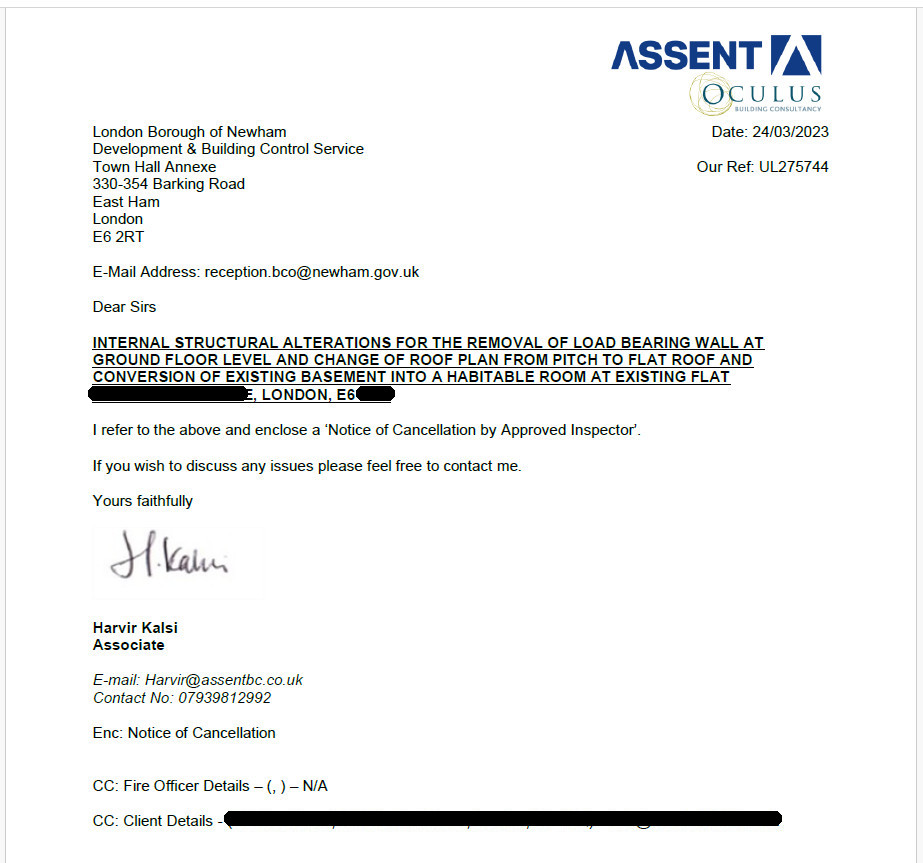
Odd that both these cancellations are the same company.
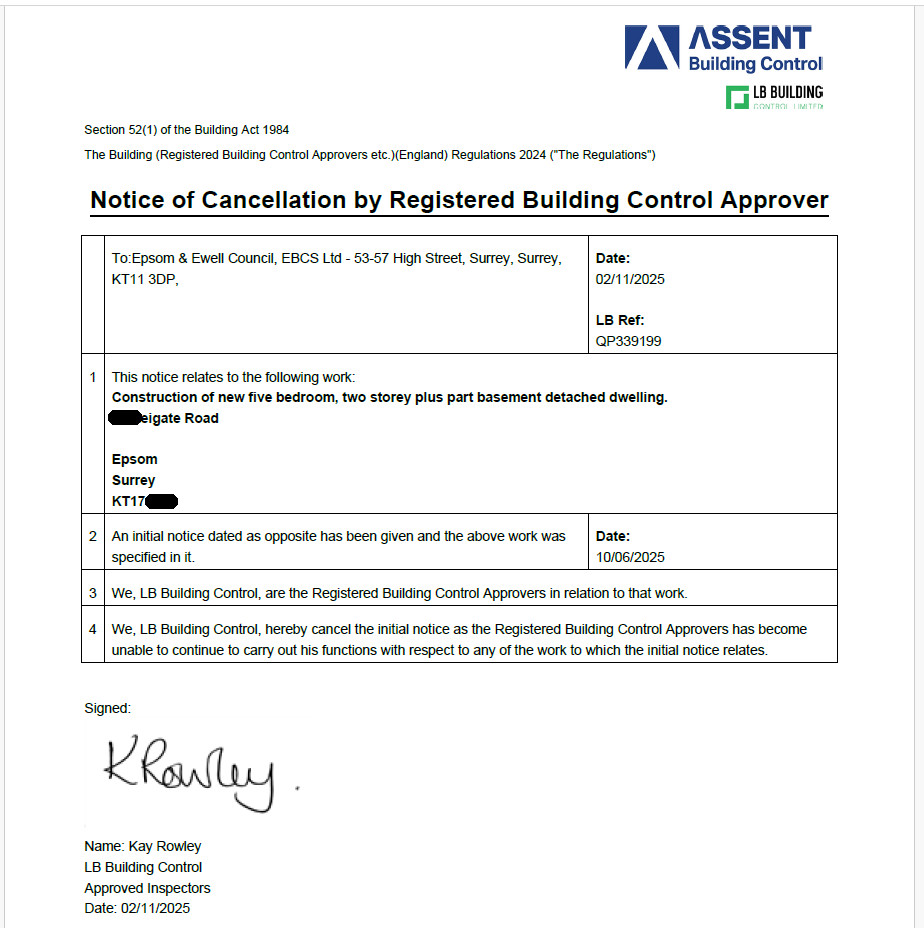
The reason for the second cancellation was they went out of business.
So what of the other two businesses tied up with it?

And what if the reason they stopped trading was a problem that will be common to all private building control bodies?
A week or so later, and a magazine article explains that all 3 trading names are in liquidation.
And, later the same month:
"Warranty providers depend on building control sign-off for technical audits. With Assent gone, certificates may be invalid or delayed, creating compliance risks and potential disputes.
Projects without proper oversight could lead to latent defect claims, forcing insurers to tighten underwriting standards or require additional inspections - adding cost and complexity for developers.
The collapse of Assent underscores the fragility of private building control in a highly regulated environment. While reforms aim to improve safety and accountability, they also demand robust financial resilience and operational capacity-something smaller and mid-sized firms may struggle to achieve.
For developers and warranty providers, the priority is clear: secure alternative building control arrangements immediately and review risk management strategies. The industry must also consider whether the current model for private building control remains viable under the weight of regulatory and insurance pressures."
Find the original article here.
Back to the Basement Building Questions Answered menu.
|
Forward to the Basement Building Construction Manual menu.
|
For a fixed fee of £199 I will answer all your questions by email. More details here.

|
Previous Page

|
|
Next Page

|
|
The Page After That
|
|
|